
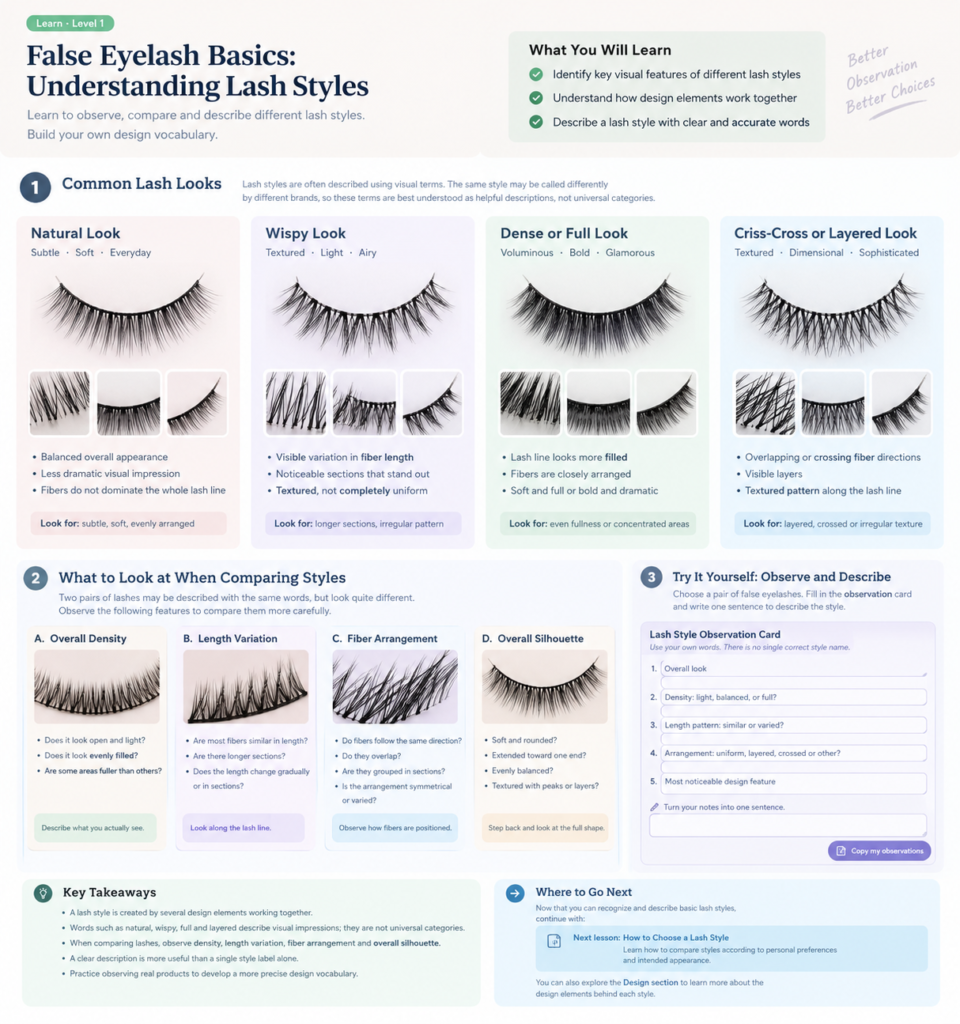
False eyelash styles are the overall visual result of several design elements working together, including length, density, fiber arrangement, and the shape of the lash line.
In this lesson, you will learn to recognize common lash looks, compare their visual features, and describe what you observe using clear and accurate words.
What You Will Learn
- Recognize common visual features of different lash styles.
- Understand how design elements work together.
- Describe a lash style using clear and accurate words.
1. Common False Eyelash Styles
Lash styles are often described using visual terms. For example, the same style may be called different names by different brands, so these terms are best understood as helpful descriptions, not universal categories.
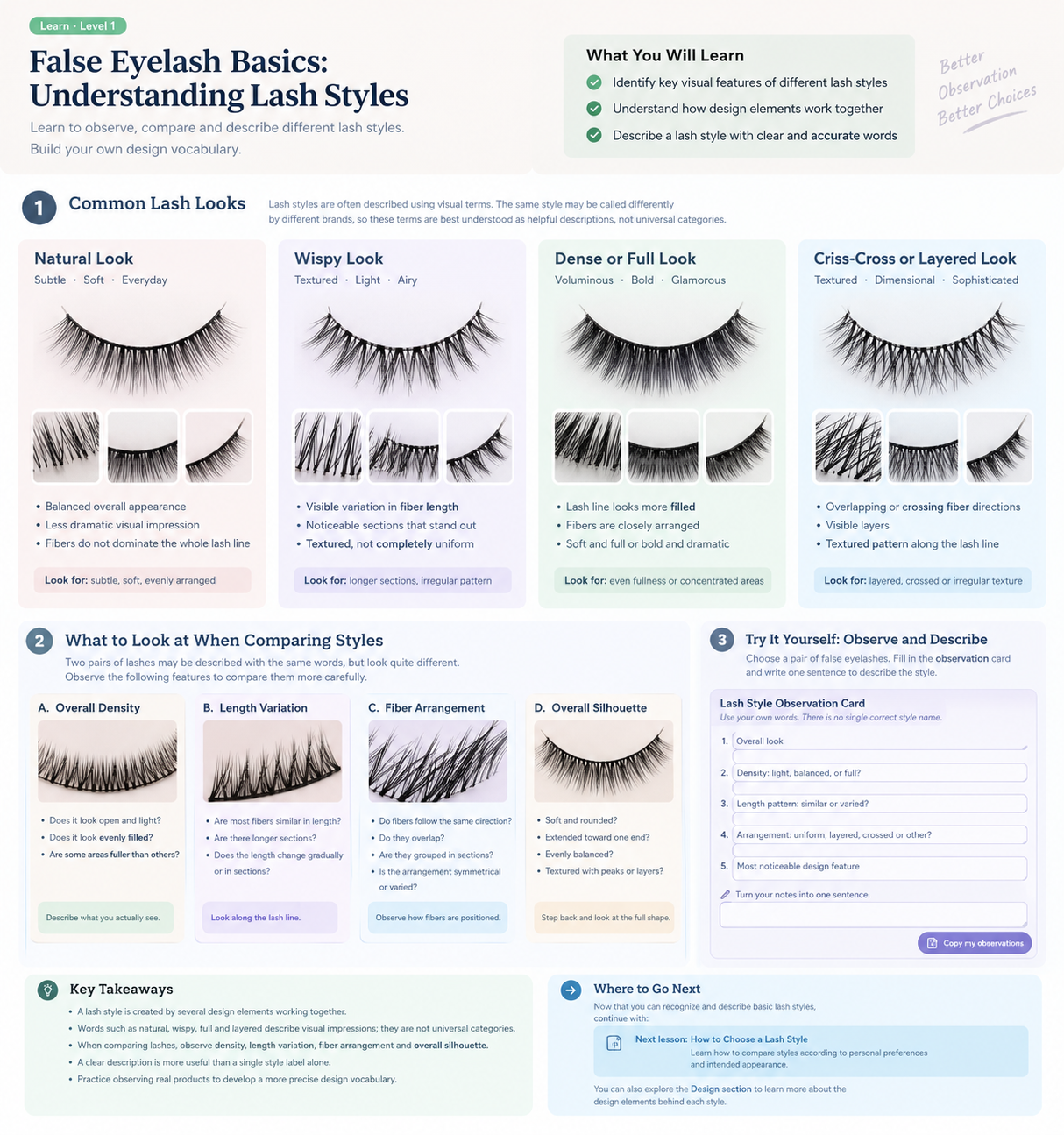
Natural Look
A natural look usually has a balanced appearance. The fibers do not dominate the lash line, and the overall effect is usually subtle.
Look for: a soft appearance and fairly even arrangement.
Wispy Look
A wispy look often includes visible variation in fiber length, with some longer sections standing out from shorter fibers. The result can appear feathery, fluffy, and textured rather than completely uniform.
Look for: noticeable length variation, a fluffy appearance, and distinct longer sections.
Dense or Full Look
A dense or full look creates a more filled-in appearance along the lash line. Fibers may be closely arranged, making the overall effect look fuller or more dramatic.
Look for: visual fullness and areas where the lash line looks more filled.
Criss-Cross or Layered Look
This look may feature overlapping or crossing fiber directions. The arrangement can create visible layers and a more textured pattern.
Look for: overlapping fibers, varied directions, or visible layers.
2. What to Look at When Comparing False Eyelash Styles
Two pairs of lashes may be described with the same words but still look different. Therefore, to compare them carefully, observe these four features:
A. Overall Density
Does the lash line look open and light, balanced, or very full? Are some areas visibly fuller than others?
B. Length Variation
Are most fibers similar in length, or are there noticeable longer sections? Does the length change gradually or in distinct sections?
C. Fiber Arrangement
Do the fibers follow a similar direction? Do they overlap, cross, or form groups? Is the arrangement relatively uniform or visibly layered?
D. Overall Silhouette
Look at the full shape of the lash line. Does it appear soft and rounded, longer toward one end, evenly balanced, or textured with visible peaks and layers?
3. Try It Yourself: Observe and Describe
Choose a pair of false eyelashes. First, look at the whole lash line; then examine the details. Finally, use the observation card below to organize what you see.
Lash Style Observation Card
- Overall look: What is your first impression?
- Density: Does it look light, balanced, or full?
- Length pattern: Are the fibers similar in length or varied?
- Arrangement: Is it uniform, layered, crossed, or something else?
- Most noticeable feature: What stands out most?
Now write one sentence: Describe the lash style using the details you observed.
Key Takeaways
- A lash style is created by several design elements working together.
- Words such as natural, wispy, dense, and layered describe visual impressions; they are not universal style categories.
- When comparing lashes, observe density, length variation, fiber arrangement, and overall silhouette.
- A clear description is more useful than relying on a style name alone.
- Practice observing real products to build a more precise design vocabulary.
Where to Go Next
Now that you can recognize and describe common lash looks, you are ready to continue learning how to compare styles according to personal preferences and intended appearance.
Coming next: How to Choose a Lash Style
Explore Learn Explore Design