
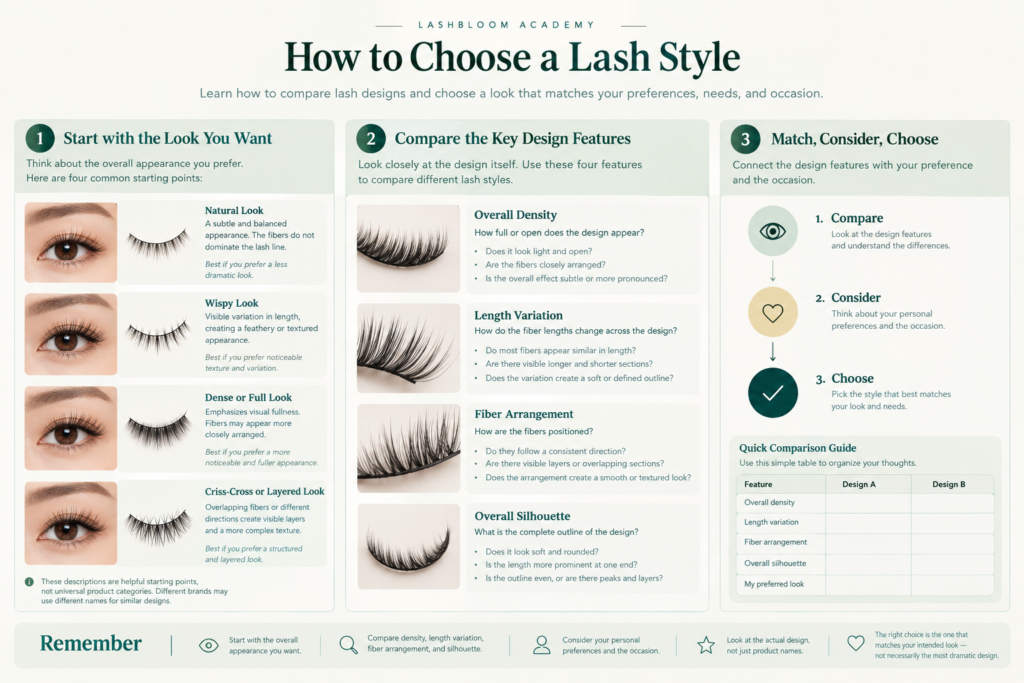
Learn how to compare lash designs and choose a look that matches your preferences, needs, and occasion.
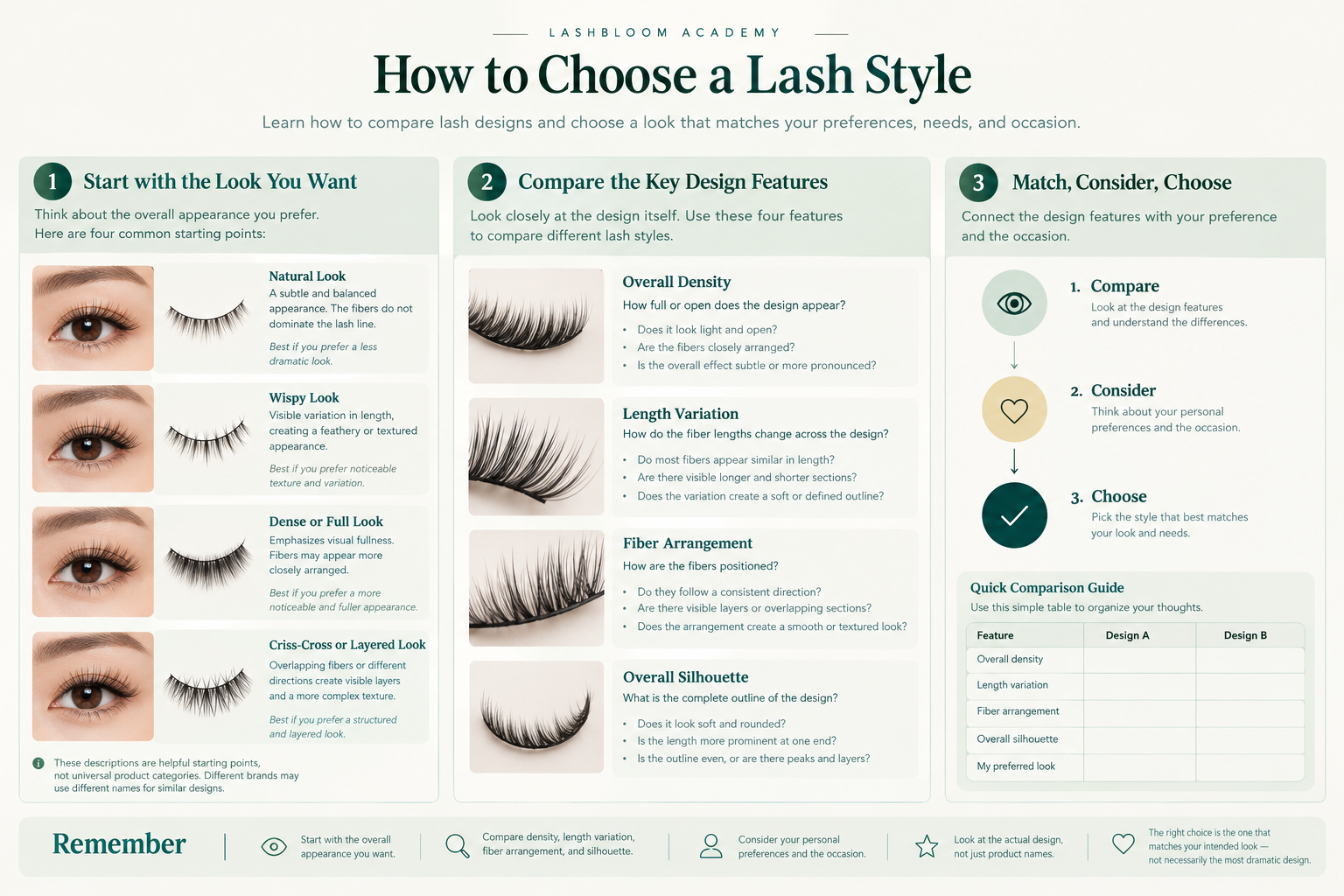
What You Will Learn
Choosing a false eyelash style can feel difficult when many products look similar or use different names for similar designs.
In this lesson, you will learn how to:
- Identify the overall look you want to achieve.
- Compare lash styles by density, length variation, fiber arrangement, and overall silhouette.
- Consider your personal preferences and the occasion.
- Look beyond product names and evaluate the actual design.
- Explain why one style appeals to you more than another.
1. Start with the Look You Want
Before comparing products, think about the overall appearance you prefer. Do you want your lashes to look subtle and natural? Do you prefer a soft, textured appearance? Or are you looking for a fuller look with more visible layers?
Here are four useful starting points:
Natural Look
A natural look is usually subtle and balanced. The fibers do not dominate the lash line, and the overall appearance is relatively understated.
Consider this look if you prefer: a less dramatic appearance.
Wispy Look
A wispy look often features visible variation in length, creating a feathery or textured appearance.
Consider this look if you prefer: a look with noticeable texture and variation.
Dense or Full Look
A dense or full look emphasizes visual fullness. The fibers may appear more closely arranged, creating a stronger overall impression.
Consider this look if you prefer: a more noticeable and fuller appearance.
Criss-Cross or Layered Look
A criss-cross or layered look may feature overlapping fibers or different directions of arrangement. This can create visible layers and a more complex texture.
Consider this look if you prefer: a design with visible structure and layered detail.
2. Compare the Key Design Features
Once you have identified the look you prefer, examine the design itself. A product name or promotional photo may not tell you everything. Try comparing these four features.
Overall Density
Density describes how full or open the lash design appears.
- Does the design look light and open?
- Do the fibers appear closely arranged?
- Is the overall effect subtle or more pronounced?
Density is not the same as length. A lash design can be long without appearing especially full.
Length Variation
Look at how the fiber lengths change across the design.
- Do most fibers appear similar in length?
- Are there visible longer and shorter sections?
- Does the length variation create a soft or more defined outline?
Length variation can change the overall impression even when two designs have a similar density.
Fiber Arrangement
Observe how the fibers are positioned.
- Do the fibers follow a relatively consistent direction?
- Are there visible layers or overlapping sections?
- Does the arrangement create a smooth or textured appearance?
The arrangement is an important part of a lash design. Two products with similar lengths may still look different because their fibers are arranged differently.
Overall Silhouette
Finally, look at the complete outline of the lash design.
- Does it appear soft and rounded?
- Does the length appear more prominent toward one end?
- Is the outline relatively even?
- Are there visible peaks, layers, or textured sections?
The silhouette helps you understand the design as a whole rather than focusing on one detail.
3. Match the Design to Your Preference
There is no single lash style that everyone should choose. Instead, connect the features you observe with the appearance you personally prefer.
| If you prefer… | You may want to look for… |
|---|---|
| A subtle appearance | A design with a relatively open or understated look |
| Visible texture | Noticeable length variation or layered arrangement |
| A fuller appearance | A design that looks visually dense |
| A more structured look | Visible layers or changes in fiber direction |
These are comparison suggestions, not strict rules. A product may combine several features, and the final appearance depends on the complete design.
4. Think About the Occasion
Your preferred style may also depend on when and how you plan to wear it.
Everyday Preferences
You may prefer a design that feels visually subtle and fits your usual style.
Work or Professional Settings
You may want to consider how noticeable the overall appearance is and whether it matches the look you prefer in that setting.
Photography or Special Occasions
You may be interested in more visible texture, fullness, or a stronger overall silhouette.
The occasion can help narrow your choices, but it should not replace your personal preference. Two people may choose different styles for the same occasion.
5. Compare Before You Choose
When comparing two or more lash products, avoid relying only on names such as “Natural,” “Volume,” or “Wispy.”
Instead, use the same questions for each product:
- How full does the design appear?
- How much variation is visible in the fiber lengths?
- How are the fibers arranged?
- What is the overall silhouette?
- Does this appearance match the look I want?
| Feature | Design A | Design B |
|---|---|---|
| Overall density | ||
| Length variation | ||
| Fiber arrangement | ||
| Overall silhouette | ||
| My preferred look |
There is no need to choose the design with the most features. The better choice is the one whose appearance best matches your own preferences and intended use.
Visual Examples
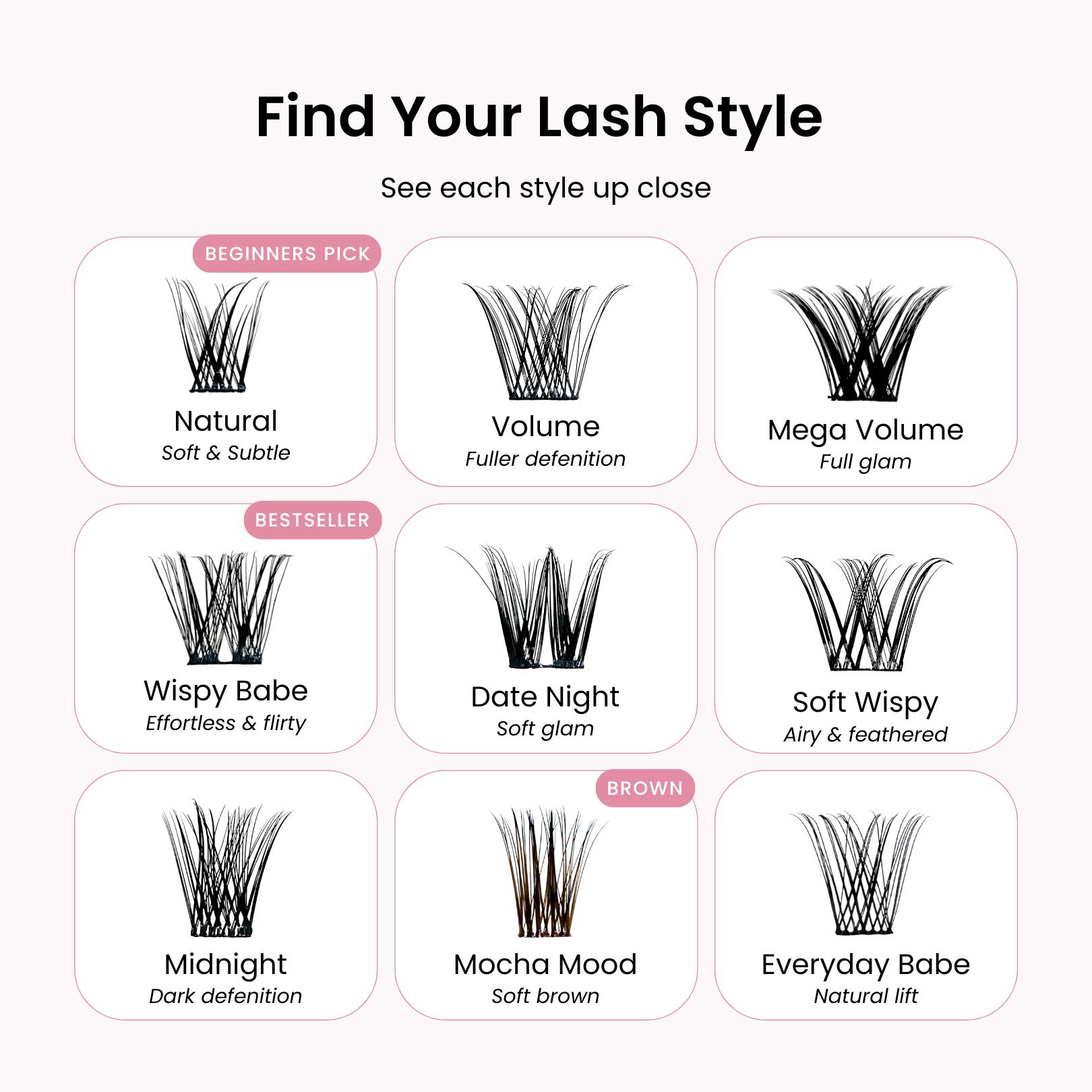
When comparing lash designs, try looking at products from the same viewing angle and at a similar scale.
Useful comparisons include:
- Two designs with similar lengths but different density.
- Two designs with similar density but different length variation.
- Two designs with different fiber arrangements.
- Several designs with different overall silhouettes.
Looking at one feature at a time makes it easier to understand what creates the difference between two designs.
Illustrative images are for learning purposes. Actual lash designs may vary.
Try It Yourself
Choose two lash designs that look different from each other. They can be product photos, samples, or designs you have seen before.
Step 1 — Describe the Look You Prefer
Choose one: Natural · Wispy · Dense or Full · Criss-Cross or Layered · Other
Step 2 — Observe the Design
- Overall density:
- Length variation:
- Fiber arrangement:
- Overall silhouette:
Step 3 — Explain Your Choice
Complete this sentence:
The goal is not to find a universally correct answer. The goal is to practice observing, comparing, and explaining your choice.
Key Takeaways
- Start with the overall appearance you want.
- Compare density, length variation, fiber arrangement, and silhouette.
- Consider your personal preferences and the occasion.
- Look at the actual design rather than relying only on product names.
- A good choice is one that matches your intended look—not necessarily the most dramatic or complicated design.
Continue Learning
Now that you know how to compare and choose a lash style, the next lesson will explore the design language behind false eyelashes.
Coming next: The Language of Lash Design
Learn how length, curl, density, and arrangement work together to shape a lash design.