
Understanding Length, Curl, Density, and Arrangement
“`htmlLASHBLOOM ACADEMY · LEARN
Every lash design is made up of details. Length, curl, density, and fiber arrangement all contribute to the way a false eyelash looks. Learning to recognize these elements can help you describe a design more clearly, compare products more thoughtfully, and understand how different features work together.
What You Will Learn
In this lesson, you will explore four important elements of lash design:
- Length: how the visible length of the fibers contributes to the overall look.
- Curl: how the curve of the fibers shapes their appearance.
- Density: how closely fibers are arranged and how full a design appears.
- Arrangement: how fiber direction, length variation, and layering create texture.
You will also learn how to observe these features together instead of judging a lash design by just one detail or product name.
1. Length: Creating Visual Emphasis
Length describes how long or short the lash fibers appear. It is one of the easiest design features to notice, but its effect depends on the other elements of the design.
Short, Medium, and Long Lengths
A design with shorter fibers may create a more understated outline, while longer fibers can make the lash line more visually prominent. Medium lengths can offer a balance between these appearances.
These descriptions are general observations, not fixed rules. The final appearance also depends on fiber thickness, density, curl, arrangement, and the shape of the complete lash design.
Length Variation
Not every lash design uses fibers of the same length. Some designs use relatively even lengths, while others combine shorter and longer fibers to create visible peaks, layers, or a textured outline.
When observing length, ask yourself:
- Do the fibers appear mostly even in length?
- Are there noticeable longer and shorter sections?
- Does the variation create a smooth outline or a more textured one?
- Where are the longer fibers positioned within the design?
Remember: a longer design is not automatically a fuller design. Length and density describe different features.
2. Curl: Shaping the Curve
Curl describes the curve of the lash fibers. It influences how the fibers appear from different viewing angles and contributes to the overall character of a lash design.
Understanding the Curve
Some fibers have a relatively gentle curve, while others have a more pronounced curve. A change in curl can make two designs with similar lengths appear noticeably different.
When looking at a lash sample or product image, try to observe the curve from the side as well as from the front. A front-facing image may not show the full shape of the fibers.
Why Curl Labels Need Context
Some lash products use letters or other labels to describe curl types. However, naming systems and specifications can vary between product categories and manufacturers. A label should not be treated as a universal measurement unless the manufacturer provides a clear definition.
When comparing curl, consider these questions:
- Does the fiber have a gentle or pronounced curve?
- Does the curve look consistent across the design?
- Are you comparing products from the same manufacturer or specification system?
- Does the viewing angle make the curve easier or harder to see?
Curl is a design feature, not a measure of length or density.
3. Density: Defining Fullness
Density describes how closely the fibers are arranged within a lash design. It contributes to the visual impression of openness or fullness.
Open and Full-Looking Designs
A design with more space between visible fibers may appear lighter or more open. A design with fibers arranged more closely together may look fuller or more compact.
Density should be considered alongside fiber thickness and arrangement. Two designs may contain a similar number of visible fibers but create different impressions because their fibers are positioned differently.
When observing density, ask:
- Does the design look open or closely filled?
- Can you see clear spaces between the fibers?
- Does the fullness appear consistent across the design?
- Do overlapping fibers make the design appear denser?
A fuller appearance does not necessarily mean that a design is longer. Likewise, a design with longer fibers can still look relatively open.
4. Arrangement: Building Texture
Arrangement describes how the fibers are positioned and directed. It includes their direction, spacing, grouping, and relationship to one another.
Consistent Arrangement
Some designs use fibers that follow a relatively consistent direction. This can create a more uniform appearance, especially when the lengths are also similar.
Layered or Textured Arrangement
Other designs combine different directions, lengths, or overlapping sections. These choices can create visible layers, peaks, and texture.
Arrangement is not limited to criss-cross patterns. It can describe many ways fibers are organized, from a relatively even layout to a more varied and layered design.
To observe arrangement, consider:
- Do the fibers follow a similar direction?
- Are there visible groups or layers?
- Do fibers overlap or cross one another?
- Does the arrangement create a smooth, even, or textured outline?
Two products may have similar lengths and density but still look different because their fibers are arranged in different ways.
5. How Design Elements Work Together
Length, curl, density, and arrangement are useful to study separately, but they work together in a complete lash design. Changing one feature may change the overall impression, even when the other features remain similar.
For example:
- Similar length, different density: Two designs may use fibers of comparable length, but one may look more open while the other appears fuller.
- Similar density, different arrangement: Two designs may appear equally full, but one may have a more even outline while the other has visible layers or texture.
- Similar length and density, different curl: The curve of the fibers may give each design a different visual character.
- Different length variation and arrangement: A design with varied lengths and layered fibers may create a more textured outline than one with more uniform fibers.
This is why product names alone are not enough to describe a design. Looking at the actual construction gives you a more useful understanding of what makes one lash style different from another.
6. Learn to Observe a Lash Design
You do not need complicated terminology to begin analyzing a lash design. Start by looking carefully and describing what you can actually see.
- Look at the overall shape. Notice whether the design appears subtle, full, even, or textured.
- Observe the length. Look for relatively even fibers or noticeable length variation.
- Check the curl. If possible, view the fibers from the side to understand their curve.
- Examine the density. Notice whether the fibers appear open or closely arranged.
- Study the arrangement. Look for direction, grouping, overlap, and visible layers.
- Describe the combined effect. Explain how these features contribute to the overall appearance.
Visual Guide: Four Elements of Lash Design
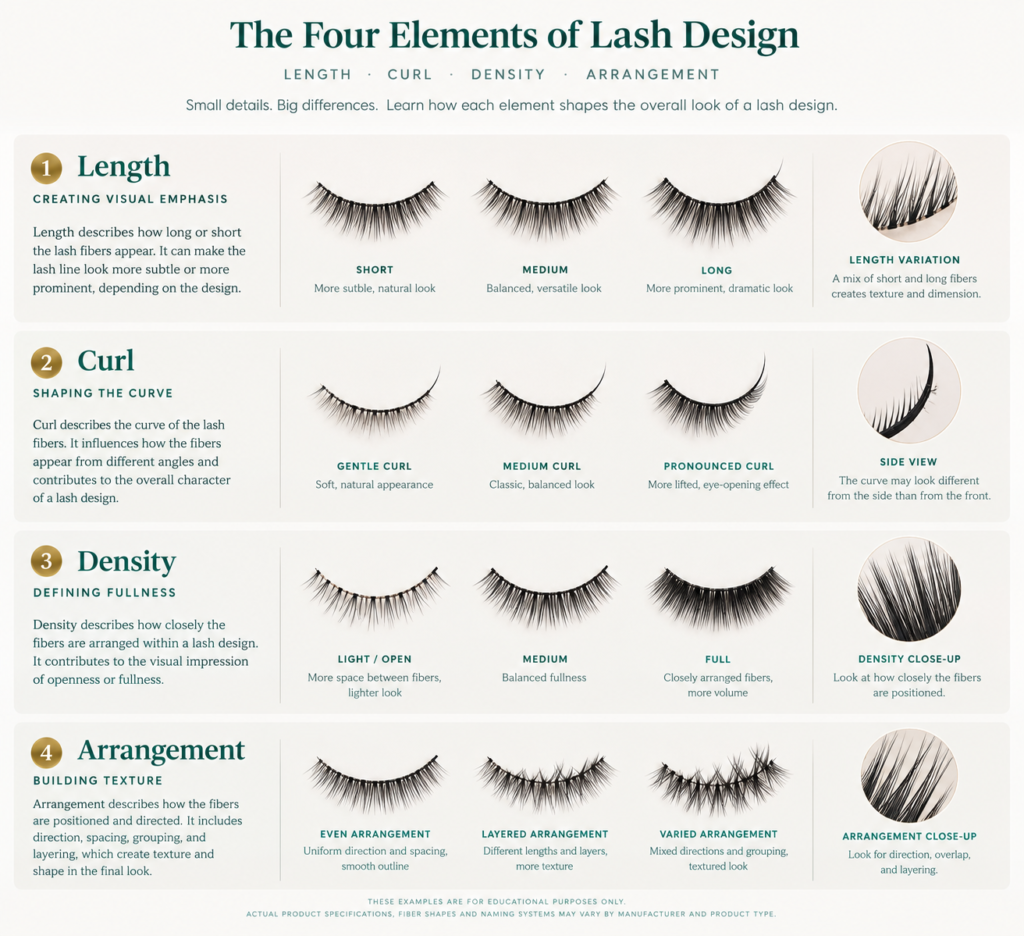
Use the visual guide below to compare the four design elements. Each comparison focuses on one feature at a time, making it easier to see what changes and what remains similar.
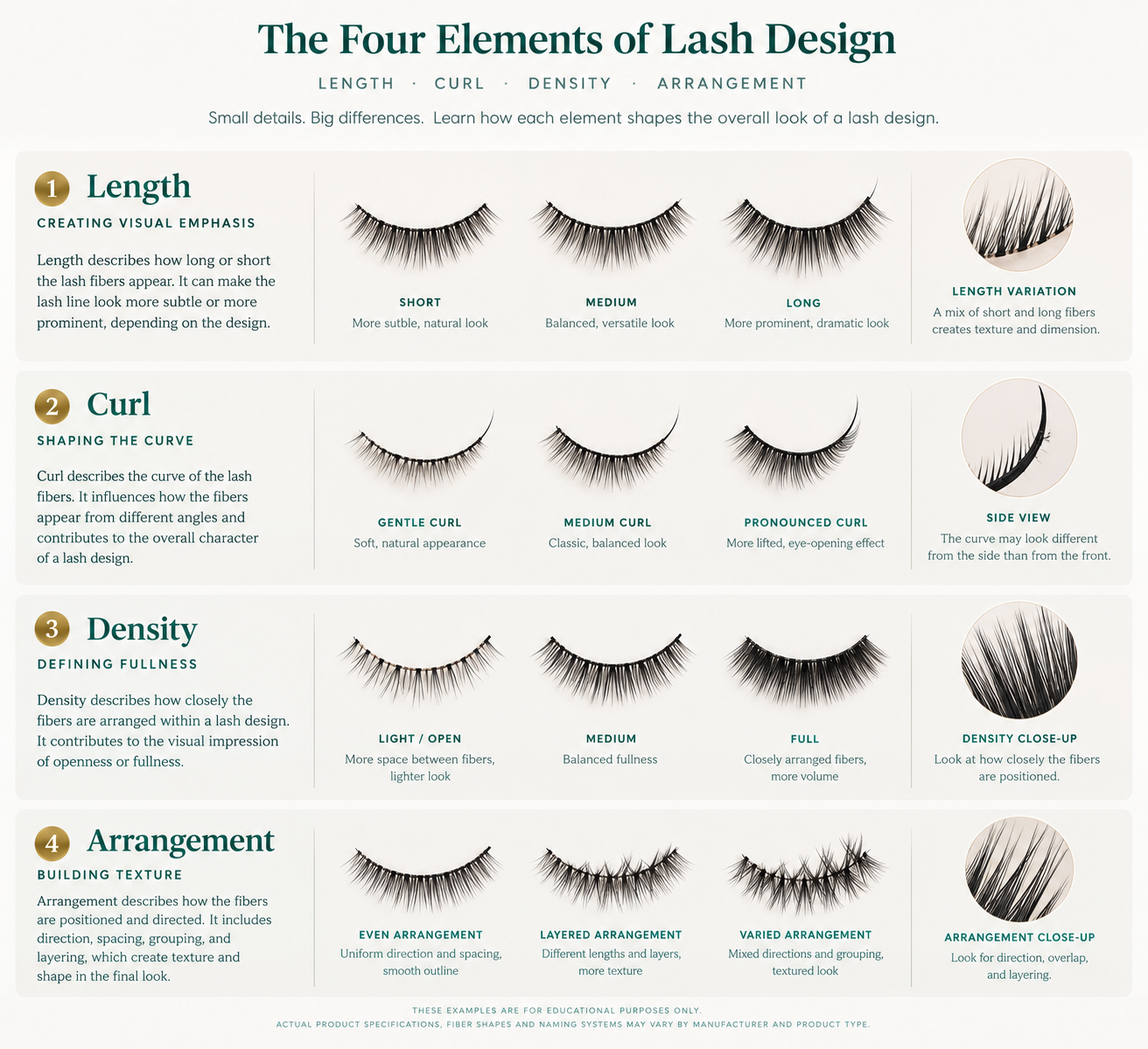
The examples are intended to explain design concepts. Actual product specifications, fiber shapes, and naming systems may vary by manufacturer and product type.
Try It Yourself
Choose two lash designs. They can be product photographs, physical samples, or designs you have seen before. Compare them using the observation worksheet below.
Step 1 — Record What You Observe
| Design Element | Design A | Design B |
|---|---|---|
| Length | ________ | ________ |
| Curl | ________ | ________ |
| Density | ________ | ________ |
| Arrangement | ________ | ________ |
| Overall Appearance | ________ | ________ |
Step 2 — Explain the Difference
Complete these sentences:
- Design A appears more __________ because __________.
- Design B has more visible __________.
- The feature that makes these designs look different is __________.
Step 3 — Describe the Design
Try describing one design in a complete sentence. For example:
“This design combines visible length variation with a layered arrangement, creating a textured overall appearance.”
Your description does not need to be perfect. The purpose is to practice observing design features and explaining what you see.
Key Takeaways
- Length describes how long or short the fibers appear.
- Curl describes the curve of the fibers.
- Density describes how closely the fibers are arranged and how full the design appears.
- Arrangement describes the direction, grouping, spacing, and layering of the fibers.
- These elements work together to create the overall appearance of a lash design.
- Observing the actual design is more useful than relying only on product names.
Continue Learning
You have now explored the four elements that help describe a lash design. In the next stage, you can use this knowledge to look more closely at how design ideas develop into product concepts and samples.
Coming next: From Lash Design Idea to Sample
Explore how an initial idea can be translated into design choices, discussed with a manufacturer, and developed into a physical sample.