
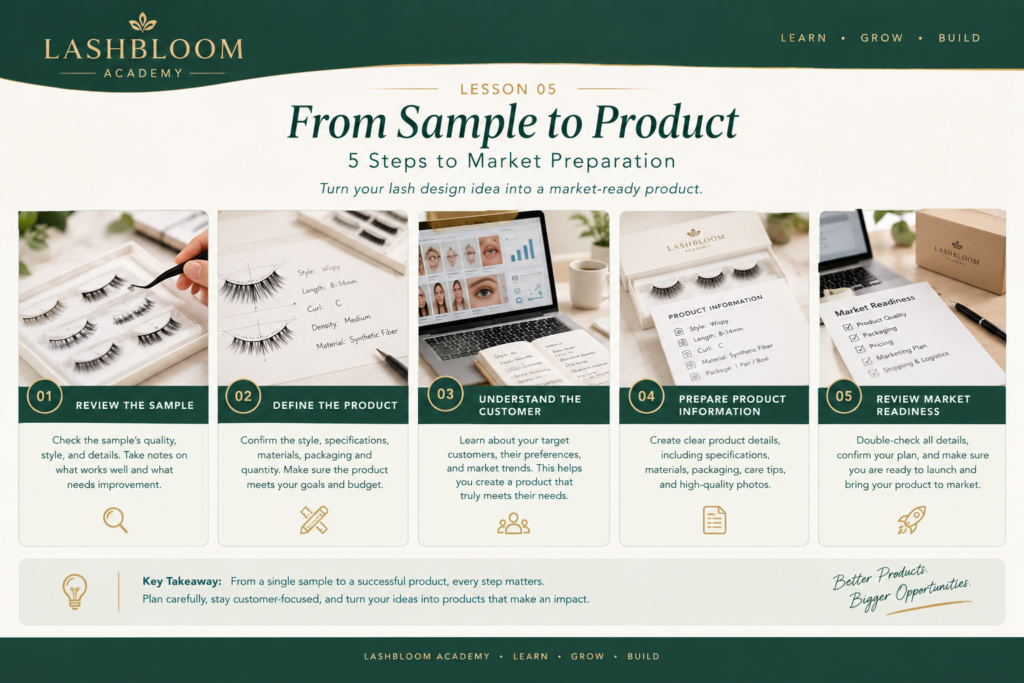
Turning a reviewed sample into a clearly defined product that is ready for market preparation.
LEARNING PATH: Recognize → Choose → Understand → Develop → Prepare
A lash sample is an important step, but a sample alone is not yet a complete product offer. Before presenting a design to customers or preparing it for sale, it helps to review the sample, define the product clearly, understand who it is for, and organize the information that customers need.
This lesson introduces a practical framework for moving from a design sample toward market preparation. The exact process may vary depending on the product, manufacturer, sales channel, and target market.
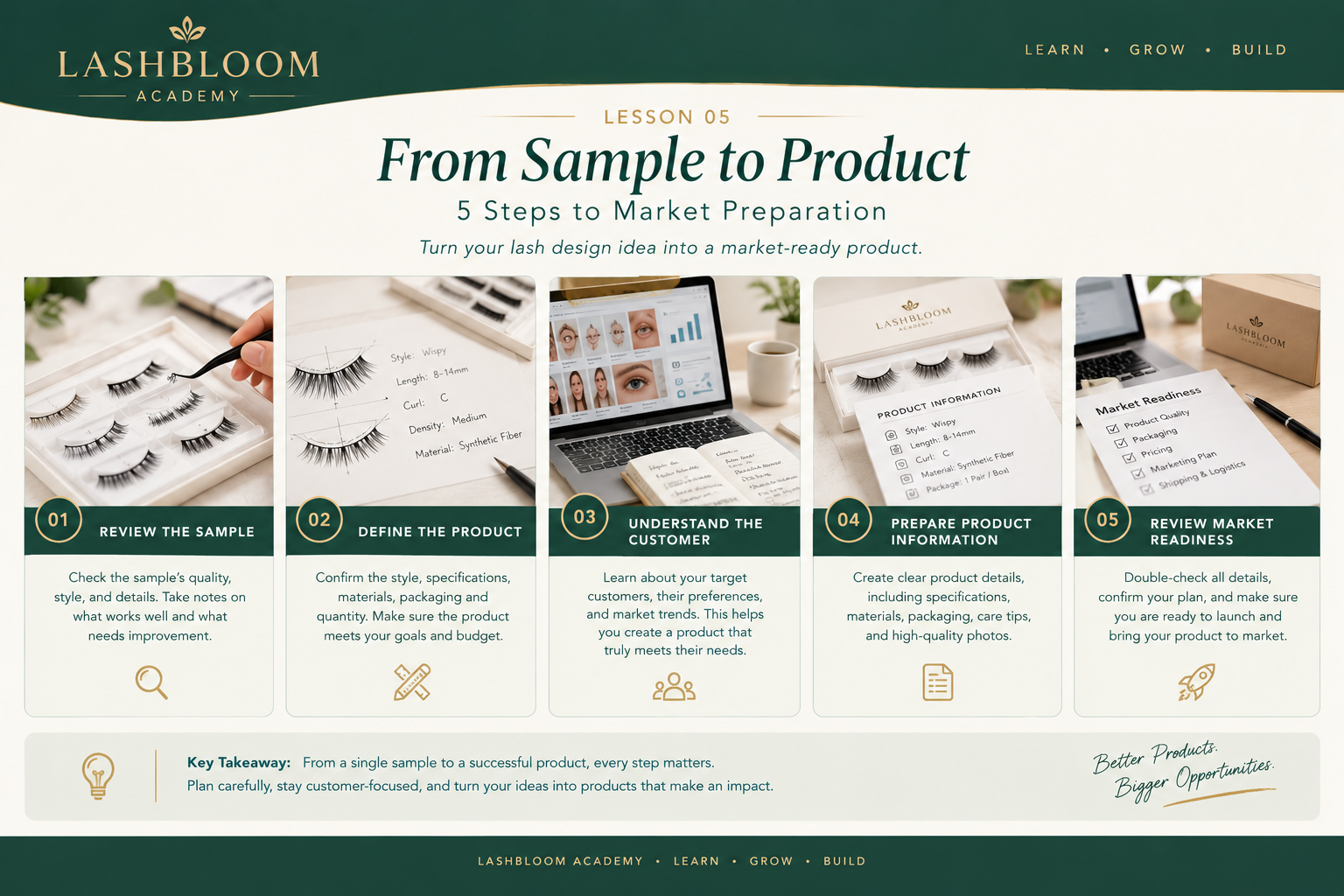
1. Review the Sample Before Moving Forward
Start by comparing the sample with the original design brief. The goal is to understand what matches the idea, what needs improvement, and what still needs clarification.
- Appearance: Does the overall look match the intended style?
- Length and curl: Are the selected specifications consistent with the design plan?
- Density and arrangement: Does the lash structure create the intended visual effect?
- Construction: Are the band, fibers, and other visible components consistent with the agreed sample?
- Repeatability: Can the manufacturer explain how the approved design will be described and reproduced?
Record observations rather than relying only on memory. If changes are needed, describe them as specifically as possible and keep a record of the sample version being reviewed.
2. Define the Product Clearly
A product should be more than a name or a photograph. A clear product definition helps designers, manufacturers, sellers, and customers understand what is being offered.
Depending on the product, useful information may include:
- Product name or design name
- Style and intended visual effect
- Length, curl, density, and arrangement, where applicable
- Materials and construction details confirmed by the manufacturer
- Available variations, such as different lengths or styles
- What is included in one package
- Product photographs or other visual references
Only include specifications that have been confirmed. If a detail is still uncertain, mark it as pending instead of presenting it as a confirmed product feature.
3. Understand the Customer and Use Context
The same lash design may appeal to different customers for different reasons. A clear understanding of the intended customer helps guide product descriptions, photographs, packaging, and the choice of sales channel.
Consider these questions:
- Who is the intended customer?
- What look or experience might this customer be seeking?
- Is the product intended for everyday wear, special occasions, professional use, or another context?
- What information would help the customer compare this product with other options?
- What questions might a customer ask before purchasing?
Avoid assuming that one design is suitable for everyone. Customer preferences differ, and product descriptions should explain the design rather than promise a particular result for every wearer.
4. Prepare Useful Product Information
Clear product information helps customers make informed comparisons and can also make communication with sales partners more efficient.
A basic product information sheet may include:
- Product identity: Name, product code, or design reference.
- Product description: A concise explanation of the style and visual characteristics.
- Confirmed specifications: Relevant dimensions, materials, variations, and package contents.
- Visual references: Product photographs that show the actual design as clearly as possible.
- Care or use information: Information confirmed for the specific product.
- Open questions: Details that still require confirmation.
Keep the information consistent across product pages, catalogues, packaging, and communications with customers. If a specification changes, review the related materials so that outdated information is not left in circulation.
5. Consider Packaging and Presentation
Packaging is part of how a product is introduced and understood. It can help identify the product, organize its presentation, and communicate relevant information.
When reviewing packaging, consider:
- Does the packaging fit the product and its intended sales channel?
- Can customers identify the style or variation easily?
- Are product names and specifications presented consistently?
- Are photographs and design elements accurate representations of the product?
- Have any required packaging or labeling details been checked for the intended market?
Packaging and labeling requirements can differ by product type and destination market. Before selling, confirm the applicable requirements for the specific product and market rather than relying on a general checklist.
6. Plan a Market-Readiness Review
Market preparation is a review process, not simply a final design decision. Before moving forward, the relevant people should understand what has been confirmed and what still needs attention.
A practical review can cover four areas:
- Product: Is the design and its key information clearly defined?
- Production: Have the manufacturer and seller agreed on the approved sample and relevant specifications?
- Presentation: Are the product images, description, and packaging information consistent?
- Market requirements: Have the requirements relevant to the product, sales channel, and destination market been checked?
Not every question will have the same answer for every product. Record who needs to confirm each open item and what evidence or information is still needed.
7. Try It Yourself: Product Preparation Checklist
Choose one lash sample and use the checklist below. Mark each item as complete, in progress, or not applicable. Add notes wherever a detail needs confirmation.
| Review item | Status | Notes |
|---|---|---|
| Sample compared with the original design brief | ________ | ________ |
| Product name or design reference recorded | ________ | ________ |
| Key specifications confirmed | ________ | ________ |
| Intended customer and use context considered | ________ | ________ |
| Product description prepared | ________ | ________ |
| Product photographs or visual references prepared | ________ | ________ |
| Packaging and presentation reviewed | ________ | ________ |
| Relevant market requirements checked | ________ | ________ |
| Open questions and next actions recorded | ________ | ________ |
Key Takeaways
- A sample should be reviewed against the original design brief before the product moves forward.
- A clear product definition helps everyone work from the same information.
- Customer understanding can guide product descriptions and presentation.
- Product information should be accurate, consistent, and based on confirmed details.
- Packaging and market requirements need to be considered for the specific product and destination.
- Recording open questions makes the next steps easier to manage.
Continue Learning
You have now followed the learning path from recognizing lash styles to preparing a design for market review.
← Previous Lesson: From Lash Design Idea to Sample
Educational content only. Product development and market preparation processes vary by product, manufacturer, sales channel, and destination market.
“`